5-day Gaza truce extension holding - CCTV News - CCTV.com English
Saturday, 16 August 2014


Thursday, 10 April 2014
Empathy in action
"I will not be a bystander"
Prof Mohammed Dajani Daoudi responds to critics who denounced his decision to take a group of Palestinian students to Auschwitz-Birkenau

I will not be a bystander
Prof Mohammed Dajani Daoudi responds to critics who denounced his decision to take a group of Palestinian students to Auschwitz-Birkenau
I will not be a bystander
Al-Quds University issued a statement to distance itself from the tour.
In a statement, Al-Quds University announced that it had nothing to do with the Auschwitz-Birkenau visit. The university said that this was a private visit by Professor Dajani and the students. "They do not represent the university," the statement said. "Professor Dajani is on leave and was not entrusted by the university [to arrange the visit]." Bir Zeit University issued a statement saying no students from the university participated in the trip.
A scathing attack on me and students filled the social media.
"I don't understand how the [Palestinian] students accept normalization [with Israel]," wrote a Palestinian journalist from Ramallah on his Facebook page. "This professor is the king of kings of normalization."
The leading Palestinian daily, Al-Quds, which reported about the visit, triggered a heated debate among readers about the visit.
The paper later had to delete some reader responses that accused me of treason and collaboration. When the inciting comments reached a peak the newspaper withdrew the article with all its comments. I received emails warning me not to go to Ramallah or the university. I was accused of of trying to change the Palestinians' mentality "by brainwashing generations and teaching them big lies and fabrications such as the Holocaust and the suffering of Jews so that they would accept the theft of their land."
Palestinian columnist Abdullah Dweikat expressed regret over the visit and called on Palestinian academics to stop the "pilgrimage" to Nazi death camps. "I felt pain over the visit by Palestinian university students to Auschwitz-Birkenau," he wrote. "Yes we are human beings who reject genocide. But our humanity rejects any attempt to bypass the suffering of our people, who are being slaughtered every day at the hands of the occupiers. Wouldn't it have been better had our professors and students visited Yarmouk refugee camp [in Syria] or refugee camps in Lebanon to see the real suffering?" Others said this is not freedom of expression but treason.
My response to all this tirade is that my duty as a teacher is to teach, to have my students explore the unexplored, to open new horizons for my students, to guide my students out of the cave of perceptions and misperceptions to see the facts and the reality on the ground, to break the walls of silence, to demolish the fences of taboos, to swim against the tide in search of truth, in sum, to advance the knowledge and learning of my students in adhering to the verse in the Holy Quran, "{And say My God increase my knowledge.}.. If there are those who do not see or do not like that, it is their problem not mine. I will go to Ramallah, I will go to the university, I will put my photos of the visit on facebook, and I do not regret for one second what I did. As a matter of fact, I will do it again if given the opportunity. I will not hide, I will not deny. I will not be silent. I will not remain a bystander even if the victims of the suffering I show empathy for are my perpetrators and my occupiers. And this is my final statement on this issue..
(From the Hearts of Flesh - Not Stone Facebook page)
In a statement, Al-Quds University announced that it had nothing to do with the Auschwitz-Birkenau visit. The university said that this was a private visit by Professor Dajani and the students. "They do not represent the university," the statement said. "Professor Dajani is on leave and was not entrusted by the university [to arrange the visit]." Bir Zeit University issued a statement saying no students from the university participated in the trip.
A scathing attack on me and students filled the social media.
"I don't understand how the [Palestinian] students accept normalization [with Israel]," wrote a Palestinian journalist from Ramallah on his Facebook page. "This professor is the king of kings of normalization."
The leading Palestinian daily, Al-Quds, which reported about the visit, triggered a heated debate among readers about the visit.
The paper later had to delete some reader responses that accused me of treason and collaboration. When the inciting comments reached a peak the newspaper withdrew the article with all its comments. I received emails warning me not to go to Ramallah or the university. I was accused of of trying to change the Palestinians' mentality "by brainwashing generations and teaching them big lies and fabrications such as the Holocaust and the suffering of Jews so that they would accept the theft of their land."
Palestinian columnist Abdullah Dweikat expressed regret over the visit and called on Palestinian academics to stop the "pilgrimage" to Nazi death camps. "I felt pain over the visit by Palestinian university students to Auschwitz-Birkenau," he wrote. "Yes we are human beings who reject genocide. But our humanity rejects any attempt to bypass the suffering of our people, who are being slaughtered every day at the hands of the occupiers. Wouldn't it have been better had our professors and students visited Yarmouk refugee camp [in Syria] or refugee camps in Lebanon to see the real suffering?" Others said this is not freedom of expression but treason.
My response to all this tirade is that my duty as a teacher is to teach, to have my students explore the unexplored, to open new horizons for my students, to guide my students out of the cave of perceptions and misperceptions to see the facts and the reality on the ground, to break the walls of silence, to demolish the fences of taboos, to swim against the tide in search of truth, in sum, to advance the knowledge and learning of my students in adhering to the verse in the Holy Quran, "{And say My God increase my knowledge.}.. If there are those who do not see or do not like that, it is their problem not mine. I will go to Ramallah, I will go to the university, I will put my photos of the visit on facebook, and I do not regret for one second what I did. As a matter of fact, I will do it again if given the opportunity. I will not hide, I will not deny. I will not be silent. I will not remain a bystander even if the victims of the suffering I show empathy for are my perpetrators and my occupiers. And this is my final statement on this issue..
(From the Hearts of Flesh - Not Stone Facebook page)
Saturday, 22 March 2014
The 7 Bogies of Moshe Ya’alon
 |
| "Bogie" Ya'alon. Never has a handle been more aptly applied |
By Matthew Kalman
Israel’s Defense Minister Moshe Ya’alon is back in the news following his latest childish outbursts against the US administration. I have never failed to be impressed with the extent of his crushing stupidity. His nickname is “Bogie.” Never has a handle been more aptly applied. Here are 7 of Ya’alon’s most embarrassing gaffes:
1. As head of IDF Central Command, responsible for the West Bank, and then deputy chief of staff, he was one of the key Israeli generals responsible for the pitiful intelligence failure that missed the looming and very obvious signs that the Second Intifada was about to erupt in September 2000.
2. In November 2000, when he was the IDF deputy chief of staff, I asked Ya’alon why the Israel military was responding to the intifada with the clearly ineffectual and probably counter-productive tactic of bombing Palestinian prisons and police stations. His answer: “You want they should hit us and we don’t hit back?”
3. Ya’alon was one of the architects of the catastrophic IDF response to the Second Intifada, which not only failed to stem the violence but escalated it, prolonging the uprising by several years. He was one of the key generals whose adoption of the tactic of targeted assassinations in Bethlehem and Tulkarm led directly to the Palestinian deployment of suicide bombers.
4. As IDF chief of staff from 2002-2005, Ya’alon masterminded the redeployment of the IDF after Operation Defensive Shield in 2002. He so degraded the IDF’s military, logistical and intelligence capability that when the Lebanon War broke out in 2006 the army lacked training, basic equipment and clear lines of intelligence communication.
5. During a study break at the Shalem Center in Jerusalem, Ya’alon publicly called for the assassination of then-Iranian President Mahmoud Ahmadinejad. “We have to consider killing him. All options must be considered,” he wisely told the Sydney Morning Herald.
6. As vice-premier, Ya’alon publicly clashed with his prime minister over attacking Iran, describing military action as “a last resort.” “Iran's nuclear program could be stopped without military force,” he said in October 2012. This week he peformed a 180-degree flip-flop.
7. Since January, Defense Minister Ya’alon has described the US Secretary of State as “obsessive and messianic,” in his pursuit of a peace deal and this week publicly accused the White House of “demonstrating weakness.”
Thursday, 2 January 2014
Holy Writ
SACRED SCRIBBLES IN BETHLEHEM
by MATTHEW KALMAN
CCTV December 31, 2013
CCTV December 31, 2013
Twitter for twits
Danny Seaman: The Israeli official whose career died from foot-in-mouth disease
The former director of the Government Press Office never let Israeli policies get in the way of provocative propaganda.

I shall miss Danny Seaman, the former director of the Israel Government Press Office.
Seaman was suspended from his position as social media guru and deputy director-general for information at the Public Diplomacy and Diaspora Affairs Ministry last August after a series of flaming Facebook posts that insulted Muslims, Palestinians and Japanese in equal measure.
Seaman is no longer in government. I mistakenly placed him there this morning when I shared his latest wisdom – a measured response to the untimely death Wednesday in Prague of Palestinian Ambassador Jamal al-Jamal, killed when an old safe exploded in his home.
“Guess you can say that the Palestinian ‘Ambassador’ to the Czech Republic died of natural causes,” Seaman commented. Minutes after I shared it with my own Facebook followers, he removed it and, sadly, demoted me from his list of “friends.”
Friday, 27 December 2013
War of words and pictures
Israel Defence Forces deploy 'selfie squad' to improve image
Combat camera unit 'here to explain and to document for the entire world that we don't use force for bad'
______________________________
theguardian.com, Friday 27 December 2013 13.12 GMT
Matthew Kalman in Jerusalem
theguardian.com, Friday 27 December 2013 13.12 GMT
______________________________

Palestinian
protester Mustafa Tamimi lies fatally injured after IDF troops fired a
teargas canister at him in 2011. Photograph: Haim Schwarczenberg/AP
Having suffered a PR battering from viral video clips showing its soldiers in an unflattering light, the Israel Defence Forces are firing back with a combat camera unit trained to show their side of the story.
The
first round of graduates - all combat soldiers - have completed a
seven-month training programme before joining front-line units. Private
Ido H, one of the new "selfie squaddies", has trained for more than a
year as a combat soldier and videographer. He can film, edit and
broadcast from the battlefield.
"My
main mission is to film. I think the job of anyone recording what
happens is much more important than any fighter," he told the Guardian.
"There are lots of cameras on the other side. They show us apparently
acting in an unfair way to civilians, to our enemies. We are here to
explain and to document for the entire world that we don't use force for
bad."
In recent years, cameras wielded by human rights groups
have focused unwelcome attention on the IDF. The Israeli human rights
group B'Tselem has distributed cameras to Palestinians and collected
hours of footage documenting life under occupation. Palestinians say
they are sometimes the only effective weapon against an army equipped
with tanks and fighter jets.
Last
April, Lt Col Shalom Eisner was suspended after he was filmed striking a
Danish protester in the face with his M16 rifle. Video showing Mustafa
Tamimi apparently dying after being hit by a teargas canister during a
West Bank demonstration in December 2011 has helped sustain pressure for
an inquiry.
But
the IDF says videos can be tendentious. In July, human rights groups
assailed the army over film of a five-year-old boy and his father being
arrested and blindfolded after he threw stones at Israeli cars in
Hebron. The army argued the editing failed to show what they described
as an hours-long effort to return the boy safely to his family via the
Palestinian police.
Major
Micha Ohana, the new unit's commander, denied his soldiers were being
trained in disinformation. "If there are errors or other things we will
present them and if necessary we will apologise or explain. But of
course we won't blur, or lie or say they didn't happen," Ohana said.
B'Tselem
welcomed the new unit. "More documentation is a very positive thing,"
said B'Tselem spokeswoman Sarit Michaeli. "There are a lot of arguments
about the facts of various incidents. The problem is that the army
doesn't release this footage and when it does, it releases very heavily
edited sequences."
Haitham
Katib, a Palestinian who has spent eight years filming protests against
attempts to build Israel's security barrier through the middle of his
village farmland in Bil'in, said cameras helped everyone.
"I
feel that my camera can stop some of the violence," said Haitham Katib.
"If the soldiers see you filming, they stop their violence. Sometimes
they broke my camera. They stopped me filming many times. They shoot me
sometimes with rubber bullets. But 70% I believe my camera has stopped
the violence."
Katib said Israeli soldiers had started to film him while he was filming them.
"It's
like we're fighting with cameras," he said. "I would like everyone to
use a camera. It means we are searching for the truth."
Wednesday, 25 December 2013
Christmas Cracker
Ancient burial box claimed to have earliest reference to Jesus
Limestone burial box is typical of first century Jerusalem and has chiselled on side "James, son of Joseph, brother of Jesus"
______________________________________________________________
Matthew Kalman in Tel Aviv
The Guardian, Wednesday 25 December 2013 16.41 GMT
______________________________________________________________
Matthew Kalman in Tel Aviv
The Guardian, Wednesday 25 December 2013 16.41 GMT
______________________________________________________________

Tel Aviv antiquities collector Oded Golan with the stone burial box
bearing the inscription "James, son of Joseph, brother of Jesus."
Photograph: Matthew Kalman/theguardian.com
For 2,000 years, pilgrims and archaeologists have hunted for physical
evidence of Jesus and his family, without success. But now an ancient
burial box claiming to contain the earliest reference to the Christian
saviour is about to go on public display in Israel after its owner was
cleared of forgery. It has not been seen in public since a single, brief
exhibition in Toronto in 2002.
The
modest limestone burial box, known as an ossuary, is typical of first
century Jerusalem, and is owned by Oded Golan, an Israeli antiquities
collector. Chiselled on the side are the words "James, son of Joseph,
brother of Jesus."
James
the Just was the first leader of the Christians in Jerusalem after the
Crucifixion. He was executed for apostasy by the local rabbinical court.
At
that time, Jews were not buried but laid in a cave. The bones were
collected after a year and placed in an ossuary. Thousands have been
discovered, some of them inscribed with names to identify whose bones
they contain. One other ossuary mentions a brother.
"This
is the oldest evidence that mentions the name of Jesus Christ," said
Golan, who bought the box in the 1970s but did not realise its
significance until Sorbonne Professor Andre Lemaire noticed it in
Golan's collection.
Lemaire published his findings in 2002 and the ossuary was briefly displayed at a Toronto museum, causing a worldwide sensation.
But
sceptics questioned its authenticity. In 2003, the Israel Antiquities
Authority seized the ossuary and appointed an expert committee who
dubbed it a fake. Golan was arrested and charged with forging the
mention of Jesus.
After
a 10-year investigation and criminal trial, Golan was found innocent of
forgery in 2012. Despite the verdict, doubts remain.
"Because
of the differences in the depth and the clarity and the kerning between
the first half of the inscription that mentions James son of Joseph,
and the second half, I'd be willing to wager that the second half was
added in modern times," said Professor Christopher Rollston of the
Albright Institute of Archaeological Research in Jerusalem.
But others disagree.
"The inscription is written in the Jewish script, it was done with a
sharp instrument and I think it was done by the same hand. It is an
authentic inscription," said Professor Gabriel Barkay of Bar-Ilan
University.
Golan
cites expert evidence from the trial showing the patina - a biological
crust formed on ancient objects - inside the grooves of the inscription.
"There is no doubt that it's ancient, and the probability is that it belonged to the brother of Jesus Christ," said Golan.
Although
Golan's trial ended last year, the ossuary was returned only a few
weeks ago by the Israel authorities. Golan plans to put it on public
display, together with the expert opinions from the trial, so that
scholars and the public can decide for themselves whether this box did
truly contain the bones of the brother of Christ – a unique piece of
concrete evidence of the family of Jesus.
CLICK HERE FOR FULL COVERAGE OF THE JAMES OSSUARY TRIAL
Holy Writ - Haaretz version
מרבית המבקרים בכנסיית המולד בבית לחם שמים פעמיהם ישר למערה שמתחת למזבח, שבה, על פי המסורת, נולד ישו לפני 2014 שנים. קארן סטרן, היסטוריונית מברוקלין קולג' שבניו יורק, שבאה השנה למקום בגל המבקרים שלפני חג המולד, נראית כעוף מוזר בכנסייה. בשונה מאחרים, היא מתעניינת יותר בעמודים שגובהם שישה מטרים, ותומכים בתקרה אותה בנה הקיסר יוסטיניאנוס במאה השישית לספירה.
הפנס של סטרן מאיר באפלולית מאות צלבים קטנטנים החרוטים על פני ארבעה טורי עמודים, אשר למרבה הפלא לא משכו את תשומת לבם של החוקרים עד לתחילת שנה זו. זוהי מלאכתם של צליינים, שביקשו להותיר את חותמם על מקדשי הנצרות שנים רבות לפני שאמן הרחוב בנקסי הפך את קירות בית לחם לרקע לאמנות רחוב ברמה בינלאומית. במבט מקרוב, שכן הסימנים כמעט בלתי נראים על רקע האבן האדומה זרועת הנימים הלבנים, ניתן לראות מאות כתובות דיו המכסות את העמודים מהקרקע ועד לגובה ניכר.
כתובות רבות מתאימות יותר לספסלים בפארק מאשר למקום הולדתו של ישו, ומשוות למקום מראה כשל לוח מודעות באכסניית תרמילאים עתיקה במיוחד. מאזן ומוסטפה פשוט ציינו שם את שמותיהם, חסן הותיר חתימה מסולסלת על כל אחד מ–44 העמודים, ו"MAH" חתם על העמוד ב–1940, בדיוק מעל "YM", שביקר במקום ב–1938. בין התפילות השונות ניתן למצוא שם גם קטעים מהתנ"ך ומהקוראן, והמלים "אלוהים זכור אותי" מופיעות במספר שפות. אברהים התפלל למען אשתו האהובה, סועאד, והביע תקווה שחייה יהיו מאושרים ושהם "יישארו לנצח יחד". בשארה איבן אל־וואפי, המתפלל להגנתם ולשגשוגם של 21 בני משפחתו, הצהיר כי "כאן, במקום המבורך הזה, אני כותב בידי שלי". לצד התפילה שלו לא מצוין תאריך, אבל השמות הארכאיים שפורטו בדקדקנות מצביעים על כך שהוא לא ביקר במקום הקדוש לו כל כך בעת האחרונה
"במערב רואים בכתובות קיר סוג של השחתה", אומרת סטרן, שחקרה כתובות במקדשים שונים במזרח התיכון. "הכתובות במקדשים ובאתרי הצליינים הן תופעה שונה לגמרי. אנשים מותירים סימנים ומסרים בתקווה שאלה יועברו לעיניהם של ישויות אלוהיות או קדושים, ולעיניהם של מאמינים אחרים", היא מסבירה. לדבריה, "זה מנהג מקובל ולגיטימי, ולא ונדליזם. אנשים כותבים 'זכור אותי' במקומות קדושים, כך שכתובות הקיר האלה מבטאות אמונה דתית", הוסיפה.
החלק העליון של העמודים מכוסה בציורים של ישו, של המשפחה הקדושה ושל קדושים שונים שצוירו בתקופה הצלבנית. מתחת לבתולה גליקופילוסה ולציור של מרים וישו העולל משנת 1130, הותירו צליינים מימי הביניים דיוקנאות של עצמם בשעת התפילה. הצלבן הצרפתי לורד דה קרוסי לא הסתפק בכך, ואף צייר את שלט האצולה של משפחתו על אחד העמודים במאה ה–12.
ליסה מאהוני, חוקרת אמנות ימי הביניים באוניברסיטת דה פול שבשיקגו, רואה קשר בין הציורים בני מאות השנים בחלקם העליון של העמודים לבין כתובות הקיר בנות זמננו. "המבקרים במקומות מעין אלה, בכנסיה המציינת אתר שבו התרחש אירוע קדוש, מוצאים משמעות מיוחדת בהותרת זכר לביקורם במקום", אומרת מאהוני. "זה המקום שבו האלוהי נכח בעולמנו, ולכן זה מקום מיוחד ליצירת קשר עם האלוהות. מקום שבו התקיים מפגש אמיתי בין הארצי לאלוהי".
למרות שיצירות הצלבנים על העמודים תועדו על ידי היסטוריונים, כתובות הקיר לא זכו עד כה להתייחסות. שטרן סבורה שהן מתעדות את חייהם ומנהגיהם של אנשים פשוטים, שזכרם לא נרשם בדפי ההיסטוריה. "נותרו כאן קולות קטנים מהעבר, שהיו נעלמים לגמרי לולא הכתובות הללו", היא ציינה.
Tuesday, 24 December 2013
Netanyahu's Pollard agenda

Netanyahu 'to demand release of spy in return for peace talks concessions'
Israeli PM will demand release of Jonathan Pollard, convicted of spying for Israel against US in 1987, reports say
_________________________________________________________
Matthew Kalman in Jerusalem
_________________________________________________________
Matthew Kalman in Jerusalem
theguardian.com, Tuesday 24 December 2013 14.10 GMT
_________________________________________________________
_________________________________________________________

The
reports said Binyamin Netanyahu (pictured) would either demand
Pollard’s release when Israel signed a framework agreement, or as part
of a prisoner exchange involving Arab citizens of Israel held for
terrorist offences. Photograph: Gali Tibbon/AP
The Israeli prime minister Binyamin Netanyahu will link the release of former US naval intelligence analyst Jonathan Pollard, convicted of spying against the US for Israel, to progress in the US-sponsored peace talks with the Palestinians, Israeli media reported on Tuesday.
The reports said Netanyahu would either demand Pollard's release whenIsrael signed
a framework agreement, or as part of a prisoner exchange involving Arab
citizens of Israel held for terrorist offences, who have always been
excluded from previous agreements.
Netanyahu's
office declined to confirm or deny the story, which was reported by
most of Israel's most well-informed diplomatic correspondents – a
favoured method of leaking sensitive information.
Netanyahu appeared to be responding to mounting pressure following revelations that Britain's
GCHQ and America's National Security Agency had targeted then Israeli
prime minister Ehud Olmert, his defence minister, Ehud Barak, and
Barak's chief of staff.
Pollard
was imprisoned in 1987 and has served longer than any other spy
captured in the US. Repeated Israeli requests for his release have been
ignored, although they have lately been joined by top US officials
responsible for his prosecution, including Lawrence Kolb, deputy to then
US defence secretary Caspar Weinberger.
"We
ask that you seriously consider the requests that there have been from
top current and former American officials and release Pollard on
humanitarian grounds," said a letter to The US president, Barack Obama,
signed by more than 100 Israeli MPs and ministers ahead of a special
session in the Knesset on Wednesday.
"It's
a matter of justice," said the deputy defence minister, Danny Danon.
"The Americans can't come to us asking for more and more while Pollard
remains in prison."
Gilad
Shalit, the Israeli soldier released in a prisoner swap in 2011 after
being held for five years by Hamas, added his moral weight to the
campaign and called on "our American friends" to release him.
"After
Israel released terrorists with blood on their hands as a gesture to
the Palestinians – this is an appropriate reciprocal gesture," Shalit
wrote in a national newspaper column.
However,
some close observers of the tangled web of US-Israeli relations warned
that the latest leaks might be designed more for domestic consumption as
Netanyahu grapples with the fractious right wing of his party ahead of
next week's planned prisoner release against a background of scattered
but increasing Palestinian violence.
"There
are so many difficult issues right now on the agenda between Obama and
Netanyahu that to add Pollard to that with all of the baggage that it
carries is not likely," said Professor Gerald Steinberg of Bar-Ilan
University.
Monday, 23 December 2013
Holy Writ: A rare scoop

Graffiti and selfies record pilgrims' progress at Bethlehem shrine
Academics are only now studying messages and paintings on the Church of the Nativity's columns dating back to the Crusades
________________________________________________________________Matthew Kalman in Bethlehem
The Guardian, Monday 23 December 2013
________________________________________________________________

Pilgrims
light candles in the Church of the Nativity, in the West Bank town of
Bethlehem, the supposed birthplace of Jesus. Photograph: Oliver
Weiken/EPA
Most
visitors to the Church of the Nativity head straight for the grotto
beneath the altar where, according to tradition, Jesus was born 2014
years ago. But among the throng of pre-Christmas pilgrims this year,
Karen Stern, a historian at Brooklyn College, City University of New
York, was more interested in the six-metre-high columns built to support
the roof by the Emperor Justinian in the sixth century.
In
the gloom of the ancient nave, Stern's torch picks out hundreds of tiny
crosses scratched into the four rows of columns – a common practice of
ancient pilgrims who wanted to make their mark on the holiest shrines in
Christendom – long before Banksy helped transform the walls of
Bethlehem into a canvas for world-class street art.
Almost
invisible against the white-veined red stone, close inspection reveals
hundreds of messages scrawled in ink from floor level to high on the
columns, which have only come to the attention of scholars this year.
Much
of the graffiti is more suited to a park bench than the birthplace of
Jesus. Mazen and Mustafa simply wrote their names. Hassan signed each of
the 44 columns with an artistic flourish. MAH tagged a column in 1940,
just above YM, who visited in 1938. GS Diek signed off in English and
Arabic in 1930.
The
prayers are interspersed with scribbled passages from the Bible and
Qur'an. "God remember me," is written in the stonework in several
scripts and tongues. Ibrahim offers a prayer for his beloved wife, Suad,
hoping she will have a happy life and that they will be "together for
ever".
"Here
in this blessed place, I write this in my own hand," proclaims B'shara
Ibn al-Wafi, praying to God for the protection and prosperity of 21
family members. His prayer is undated, but the archaic names
painstakingly listed suggest it is not recent.
There
are more messages on the marble facing of the Holy Nativity grotto
beneath the altar. "God have mercy on me, I am a sinner, Deacon
Suleiman, 1960," confessed a Lebanese priest near the exit from the
grotto in the Armenian chapel dedicated to the Magi. "God remember your
servant Yusef and have mercy on his parents," says a prayer chiselled
into the marble.
More prosaically, a wall nearby is covered with names of foreign visitors like a noticeboard in a backpackers' hostel.
"In
the west today people are used to seeing graffiti as a type of
defacement," said Stern, who has studied religious graffiti in Middle
Eastern shrines, including a third-century building from Dura Europos in
Syria that may be the oldest-known church prototype. "When you see
graffiti in these shrines and pilgrimage sites, you realise that it's
actually something quite different. People are literally leaving their
marks in these places to be somehow witnessed by the divine and other
worshippers," she said.
"It
appears to be a sanctioned practice – not vandalism. People are going
to these specifically religious places to write 'remember me'. It's very
poignant and simple. This is graffiti as a form of veneration."
High
on the columns are Crusader-era paintings depicting Jesus, the holy
family and the saints. Beneath the Virgin Glykophilousa, an 1130
painting of a tenderly mothering Mary and infant Jesus, medieval
pilgrims commissioned the original selfies – freelance votive images of
themselves at prayer. The medieval French Crusader Lord de Coucy painted
his family crest on a column sometime in the 12th century. There is
another medieval coat of arms etched on the wall of the Chapel of
Joseph, beneath the Catholic section of the church.
Lisa
Mahoney, a medieval art historian at DePaul University, says there is
a link between the centuries-old paintings high on the columns and the
modern graffiti below.
"When
people visited a place like this, a church that marked the site of a
sacred event, it was important to them that they left some physical
trace of their visit behind," Mahoney said. "This is the place where the
divine entered the world so it makes it a special place for
communicating with the divine. It's a place where there's been a real
meeting of the earthly and heavenly realms."
Historians
have noted the Crusader artwork, but the graffiti has so far attracted
scant attention. Stern said it illuminates the life and practices of
ordinary souls discarded by history. "We have these small voices from
the past that otherwise would totally disappear," she said.
Up in the gods

Bethlehem's Church of the Nativity: saving the angels at Jesus's birthplace
Italian craftsmen have won the Palestinian Authority's tender to repair the fourth-century church and Unesco heritage site
______________________________
The Guardian, Monday 23 December 2013 14.53 GMT
Matthew Kalman in Bethlehem
The Guardian, Monday 23 December 2013 14.53 GMT
______________________________
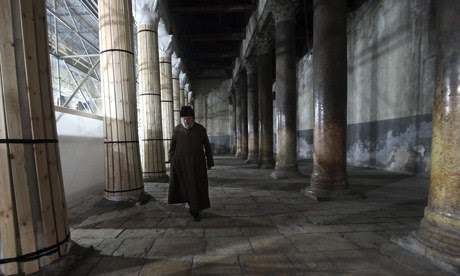
 Visitors light candles in the church. Photograph: Ammar Awad/Reuters
 A Greek Orthodox priest walks inside the Church of the Nativity ahead of Christmas in Bethlehem. Photograph: Ammar Awad/Reuters
The
sixth-century nave constructed by the Emperor Justinian is undergoing
massive restoration work. Photograph: Abed Al Hashlamoun/EPA
Italian
craftsmen have begun urgent repairs to the centuries-old roof of the
Church of the Nativity in Bethlehem, first constructed in the fourth
century over the grotto where tradition says Jesus was born 2,000 years
ago.
"Water
leaks, earthquakes and incidents that happened here in Bethlehem had a
negative impact on the whole structure and especially on the roof of the
church," said Ziad Bandak, head of the Palestinian committee overseeing
the work. "The leakage of the water affected the structure, the wood,
the walls and the frescoes and mosaics inside."
Marcello
Piacenti, head of the family business that has been lovingly restoring
the ancient shrines of Europe for six generations, said he was honoured
to have won the international tender issued by the Palestinian Authority
to repair crumbling pine and cedar timbers up to 800 years old and a
lead roof donated by Edward IV of England in 1479.
Visitors light candles in the church. Photograph: Ammar Awad/Reuters
"It's
very emotional to work here," Piacenti said as his experts applied
protective gauze to a gold-leaf mosaic of an angel high in the rafters
above the sixth-century nave constructed by the Emperor Justinian, and
technicians probed deep into the thick wooden trusses to check for
hidden damage. "This ancient structure has withstood the centuries and
we hope to make our contribution to its continuing presence here."
The
leaky roof has sparked regular clashes between mop-wielding monks from
the Greek Orthodox, Armenian and Catholic churches over who has
authority to clean which parts of the shrine shared between the three
denominations under a brittle arrangement known as the status quo. The
water damage has also harmed many of the wall frescoes and mosaics that
date back to Crusader times and beyond.
In
2009, the Palestinian president, Mahmoud Abbas, fearful that the church
might collapse, issued a decree to repair the building that the warring
parties that run the church finally accepted.
A Greek Orthodox priest walks inside the Church of the Nativity ahead of Christmas in Bethlehem. Photograph: Ammar Awad/Reuters
But
despite being declared a Unesco heritage site in 2012, the Palestinians
were able to raise only €2m of the €15m (£12.5m) required for the full
renovation of the building. In this first phase, expected to last until
next September, Piacenti's men, together with five Palestinian
colleagues, will repair or replace the roof lead and timbers and the
church's 18 upper windows.
"After we have stopped all the water leakage I hope it will be possible
to begin restoring the other materials," said Piacenti. "There are many
angels up here. I hope we can save them."
All ears
Israeli PM condemns US and UK spying on predecessor as 'unacceptable'
• NSA and GCHQ targeted email address of Ehud Olmert
• Binyamin Netanyahu demands explanation for US spying
______________________________
theguardian.com, Monday 23 December 2013 16.26 GMT
Matthew Kalman in Jerusalem
theguardian.com, Monday 23 December 2013 16.26 GMT
______________________________
 Israeli
prime minister Binyamin Netanyahu chairs a weekly cabinet meeting at
his office in Jerusalem on Sunday. Photograph: Gali Tibbon/AP
Israeli
prime minister Binyamin Netanyahu chairs a weekly cabinet meeting at
his office in Jerusalem on Sunday. Photograph: Gali Tibbon/AP
Israeli
prime minister Binyamin Netanyahu chairs a weekly cabinet meeting at
his office in Jerusalem on Sunday. Photograph: Gali Tibbon/AP
The
Israeli prime minister Benjamin Netanyahu has broken his silence over
revelations that British and US spy agencies had targeted one of his
predecessors, condemning the activities as “unacceptable”.
Papers leaked by Edward Snowden, and published by the Guardian on Friday,
revealed that GCHQ in association with the National Security Agency had
targeted an email address used by the Israeli prime minister when Ehud
Olmert was in office.
Three
further Israeli targets appeared on GCHQ documents, including another
email address understood to have been used to send messages between the
then Israeli defence minister, Ehud Barak, and his chief of staff, Yoni
Koren.
“I
have asked for an examination of the matter,” Netanyahu told members of
his ruling Likud Party at a meeting of the parliamentary faction in the
Knesset on Monday. “In the close relationship between Israel and the
United States, there are things that are prohibited and that are
unacceptable to us.”
Netanyahu
had pointedly avoided addressing the growing storm at a meeting of the
Israeli cabinet the previous day, prompting widespread media comment in
Israel that he was attempting to stifle discussion on the embarrassing
revelations about the behaviour of Israel’s closest strategic ally.
Israel
has given undertakings not to spy on the United States since the arrest
and life imprisonment of US naval intelligence analyst Jonathan Pollard
in 1987 for spying on behalf of Israel.
Netanyahu
and other Israeli leaders across the political spectrum, as well as
senior retired US security officials, have unsuccessfully petitioned
successive presidents to release Pollard, who has served a longer
sentence than any other spy in the US. Although Netanyahu repeated his
claim on Monday that the two matters should not be connected, he
pointedly met with Pollard’s wife Esther in Jerusalem and posted a video
of their handshake on his YouTube channel in response to a new groundswell of protest demanding Pollard’s immediate release in light of the latest revelations.
“I
have met with Esther Pollard and updated her on our ceaseless efforts
to liberate Jonathan. He should have been released long ago. I think
that’s understood by everyone here, and also understood by large and
growing sectors in the United States,” said Netanyahu.
Israel
and the US are locked in sensitive diplomatic manoeuvring around the
peace talks with the Palestinians. This new issue could not have arisen
at a worse time.
Several
Israeli ministers had already broken ranks and protested publicly about
NSA surveillance. Israeli anger at the US was exacerbated by a report
in Yedioth Ahronoth, the country’s largest-selling newspaper, that a US
marine rented an apartment in June 2009 directly opposite the private
home of Ehud Barak, a former prime minister and military chief of staff
who was then Israel’s defence minister.
“Israeli
intelligence detected sizeable amounts of electronic equipment
delivered to the US-rented apartment,” Yedioth reported, together with
diagrams of the sophisticated laser spying devices that might have been
used to eavesdrop on Barak’s private conversations via the vibrations of
the windows of his home.
Strategic
affairs minister Yuval Steinitz and other officials said the NSA and
GCHQ would have learned little of value from the email addresses and
phone lines they apparently intercepted, which were publicly listed
contact points and not used for the transmission of sensitive
information.
Oved
Yehezkel, a former military intelligence officer who was cabinet
secretary to then prime minister Olmert, said it was assumed that
communications between Israeli leaders were being monitored by their
closest friends in Washington. “Of course we knew. Anyone who thinks
that friends and allies don't spy on each other should re-read John le
Carré,” Yehezkel said.
Saturday, 21 December 2013
Chinese FM wraps up MidEast tour
Wang Yi meets Palestinian & Israeli leaders to boost peace talks
CCTV, December 21, 2013
By Matthew Kalman
CCTV, December 21, 2013
By Matthew Kalman
Wednesday, 18 December 2013
Rare visit suggests new profile
Trade high on agenda during Wang Yi’s visit to Israel
CCTV, December 18, 2013
By CCTV reporter Matthew Kalman
Chinese Foreign Minister Wang Yi is in Jerusalem to begin three days of meetings with Israeli and Palestinian leaders before continuing his tour of the Middle East.
China’s Foreign Minister Wang Yi arrived in Tel Aviv on Tuesday for a three-day visit to Israel and Palestine - the first visit by such a senior Chinese official since 2009 - almost as rare as the raging snowstorm that has paralyzed Jerusalem and Ramallah for most of the past week. High on his agenda with Israeli leaders are the soaring trade relations between Israeli and China, which have grown in the past 20 years from $50 million to more than $8 billion a year. China is a major consumer and investor in Israel’s fast-growing high tech industry. Israeli technology is also helping to solve China’s problems with water, waste and agriculture. The largest water desalination plant in China was built by an Israeli company.
"Israel and China are complementary economies. China has the market. Israel has the technology. Israel has the sophistication to bring China to a more modern more developed economy. That’s exactly what China lacks. It’s the edge that Israel is able to offer China." said Aurora Colson, Israel-Asia Investment Analyst.
While the United States has long been involved in the Middle East, some analysts are asking whether Beijing will also raise its diplomatic profile on such issues as the Iranian nuclear program and the Israeli-Palestinian peace process. Dore Gold, Israel’s former ambassador to the United Nations, is one of many high-ranking Israelis who have made semi-official visits to Beijing recently to seek a common language on the region’s strategic issues.
"I would expect that China could play a greater role in the Middle East but I’m not sure China is coming to replace the United States. It’s my understanding that what’s most important for China is a stable Middle East. With China drawing so much of its energy and oil from this region, I’m sure they would like to contribute to a strategically balanced Middle East." said Dore Gold, President, Jerusalem Center for Public Affairs.
This rare visit by the foreign minister comes just as Jerusalem is recovering from its worst winter storms in 50 years and all sides hope that it’s a sign of the increasing thaw in relations between the two countries.
CCTV, December 18, 2013
By CCTV reporter Matthew Kalman
Chinese Foreign Minister Wang Yi is in Jerusalem to begin three days of meetings with Israeli and Palestinian leaders before continuing his tour of the Middle East.
China’s Foreign Minister Wang Yi arrived in Tel Aviv on Tuesday for a three-day visit to Israel and Palestine - the first visit by such a senior Chinese official since 2009 - almost as rare as the raging snowstorm that has paralyzed Jerusalem and Ramallah for most of the past week. High on his agenda with Israeli leaders are the soaring trade relations between Israeli and China, which have grown in the past 20 years from $50 million to more than $8 billion a year. China is a major consumer and investor in Israel’s fast-growing high tech industry. Israeli technology is also helping to solve China’s problems with water, waste and agriculture. The largest water desalination plant in China was built by an Israeli company.
"Israel and China are complementary economies. China has the market. Israel has the technology. Israel has the sophistication to bring China to a more modern more developed economy. That’s exactly what China lacks. It’s the edge that Israel is able to offer China." said Aurora Colson, Israel-Asia Investment Analyst.
While the United States has long been involved in the Middle East, some analysts are asking whether Beijing will also raise its diplomatic profile on such issues as the Iranian nuclear program and the Israeli-Palestinian peace process. Dore Gold, Israel’s former ambassador to the United Nations, is one of many high-ranking Israelis who have made semi-official visits to Beijing recently to seek a common language on the region’s strategic issues.
"I would expect that China could play a greater role in the Middle East but I’m not sure China is coming to replace the United States. It’s my understanding that what’s most important for China is a stable Middle East. With China drawing so much of its energy and oil from this region, I’m sure they would like to contribute to a strategically balanced Middle East." said Dore Gold, President, Jerusalem Center for Public Affairs.
This rare visit by the foreign minister comes just as Jerusalem is recovering from its worst winter storms in 50 years and all sides hope that it’s a sign of the increasing thaw in relations between the two countries.
Thursday, 12 December 2013

If The Peace Talks Were A Movie

Here’s my elevator pitch. Working title: A Foreign Affair. It’s a bit like When Harry Met Sally meets Knocked Up meets Dr Strangelove.
Doe-eyed but flint-hearted former Mossad lovely Tzipi (Meryl Streep) and chubby, eloquent but iron-minded Saeb (Danny DeVito) are neighbors and on-again, off-again friends/rivals. They are each happily married with their own families and there is no question of an affair—but that simmering tension provides a backdrop for the drama that follows. Saeb has threatened to leave the neighborhood before and has planted a For Sale notice in his front yard several times, but he keeps changing his mind at the last minute.
Along comes steel-jawed, helmet-haired, former war hero John (Clint Eastwood) and asks them to look after his love-child, Salaam, due in nine months. John will not be around much longer and so he must entrust the child to their safe-keeping. They each owe him big time for past favors and they cannot refuse his request.
Alas, neither Tzipi and Saeb, sadly, can have children of their own. This could be their one slim chance of parenthood. For their own reasons, they cannot afford to pass it up. There’s also a back story on each that we won’t go into—a violent past, lots of suffering, various disappointing father figures.
READ THE FULL POST HERE
Friday, 6 December 2013
Subscribe to:
Posts (Atom)